
Consent To PLAYER entering into the Chess Tournament and Rules Agrement(Required) I have read and agree to the Guidelines and Chess Tournament Rules.
IMPORTANT: PLEASE READ FULLY
If your child is enrolled into the Smart Kids Chess Tournament, please read the following before entering the tournament.
The SMART KIDS CHESS - CHESS TOURNAMENT is a chess tournament that brings all classes of Smart Kids Chess together for both students to play and for your parents to watch you play.
The top three tournament participants will win prizes. We'll have a TOURNAMENT like this every three months and you're encouraged to participate.
PREFACE:
All chess competitions shall be played according to the FIDE Laws of Chess (E.I.01A). The
FIDE General Regulations for Competitions shall be used in conjunction with the Laws of
Chess and shall apply to all official FIDE competitions. These Rules shall also be applied to
all FIDE-rated competitions, amended where appropriate. The organizers, competitors and
arbiters involved in any competition are expected to be acquainted with these Rules before
the start of the competition. In these Rules the words ‘he’, ‘him’ and ‘his’ shall be
considered to include ‘she’ and ‘her’.
National Laws of the hosting country take precedence over FIDE Rules.
Where an event has a situation not covered by internal rules, these Rules shall be considered
to be definitive.
1.2 RULES
These Rules apply to the following levels of competition:
L1 – Official FIDE events – see FIDE Handbook, Section D, Regulations for Specific
Competitions (World Championships, Chess Olympiad, Continental Championships and so
on).
L2 - Competitions where FIDE titles and title norms can be earned, according to FIDE
Handbook B.01 (FIDE Title Regulations)
L3 - FIDE Rated Competitions, according to FIDE Handbook B.02 (FIDE Rating
Regulations)
1.3 REFERENCES
These competition rules may contain regulations defined by other FIDE Commissions,
which are listed in the FIDE Handbook. Where possible, references to these external
regulations shall be shown.
1.4 TOURNAMENT TYPE
A Five (5)-Round Swiss system is being used, however if the number of players are less than required, then the number of rounds can increase or decrease according to the arbiter. If they play a 5-Round Swiss system game then everyone plays FIVE (5) games following a method using most similar Rating to Rating and Results).
1.5 POINTS One (1) point is awarded for a win, a half-point is awarded for a draw and zero points (0) are identified for a loss. If there are an odd number of players, one (1) point is awarded <> will be given to one of the players. Players who arrive late may be awarded a half-point <> if an acceptable excuse if provided to the arbiter and a zero (0) is awarded if the player is late and the excuse is not accepted by the arbiter.
1.6. TIME CONTROL
Time control is 25 minutes per player with a 5 second increment per player. Clocks will be used on all boards. The use of the clock is at the discretion of the referee. If a physical clock is used and the game lasts more than 30 minutes with or without the use of a clock, the referee can oblige the players to
complete the game with a clock, in which case, each player will be given at least 10 minutes.
1.7. MOVES
A move has been made when a player lets go of a piece (except if the move is illegal). Touch move rules applies both in-person and online. For all players, regardless of age, the <> rule applies. In other words, if you touch a piece you must move it. Players are not required to write down their moves, however in the case of a dispute, the written moves will become evidence of your claim.
1.6. PAIRINGS
Pairings are made by the referee according to the SWISS system or it will be auto-arranged by the Smart Kids Chess pairings system. Student / Player ratings are used and we mainly focus on your FIDE or CFC rating in that respective order. Decisions made by the Tournament Director or Arbiter and all decisions are final. There is no appealing of a decision.
1.7 TIES
Ties are broken with play-off games to determine the Top three (3) places. At the discretion of the arbiter, a third place may be determined by a computer tie-break and a fourth place through tenth place will be determined by a computer tie-break. Playoff games will be rated. For the playoffs, players will be given a minimum of 10 minutes each to checkmate.
1.8. PLAY ROOM
Parents, family members and or friends and coaches, etc. are not permitted in the playing room. When a student and or players game has ended they must leave the playing area. We request that silence from all who attend the tournament within the play area and corridors be respected and if otherwise; those who do not respect this rule may be asked to leave or vacate the area.
1.9. RESULTS
Winners must give their results to their arbiter and or referee. In the case of a drawn game, both players must turn in the result.
1.10. ISSUES
If a player has an issue, they must immediately raise their hand and request a ruling from the arbiter / referee. A complaint will not be addressed after a game has ended. Complaints must be heard during the time that there is still time on players clocks and whereby the game has not ended. Any decision by a referee may be appealed, if done immediately, to the chief tournament director. The decision of the chief tournament director is final.
1.11. ISSUE PROCEDURE
If a player has any questions concerning the rules, they may raise their hand and talk to an arbiter and or referee. In case of any issue, dispute or claim, stop the clock and summon a referee. Only the two players in that game may make claims concerning their game and parents nor any other persons are not allowed to get involved. For example, other players nor parents or anyone may not call touch move or indicate that time has expired in someone else's game and referees will NOT call touch move or indicate that time has expired as this will be entirely up to the players of that game if they choose to make that call.
1.12. ONLINE LOGIN
If attending the tournament online, FIFTEEN-MINUTES (15) BEFORE tournament begins, use your web browser and go to the Smart Kids Chess Platform "class.smartkidschess.com" and go to the TOURNAMENT AREA and accept your invite before the start of the tournament.
1.13. TOURNAMENT START TIME
Tournament begins at the identified START TIME, do not be late. Be prepared to begin your game at the start time and be prompt. When your clock begins, there is no pausing of time and no resetting of the time clock. If you are late for the tournament and you do not respond during the time your name is called at the start of the tournament; you will forfeit your entry fee and will not be able to join the tournament after which time the tournament is started. This is because, once the tournament is started and all players have joined who were called; the system automatically locks all players into the platform and a strict clock time is started to ensure all players are given a fair and timely match. At that time, no player can be added and the judges, arbiters, nor game officials can add any new player into the tournament. Do not be late under any circumstances.
1.14. CAMERAS
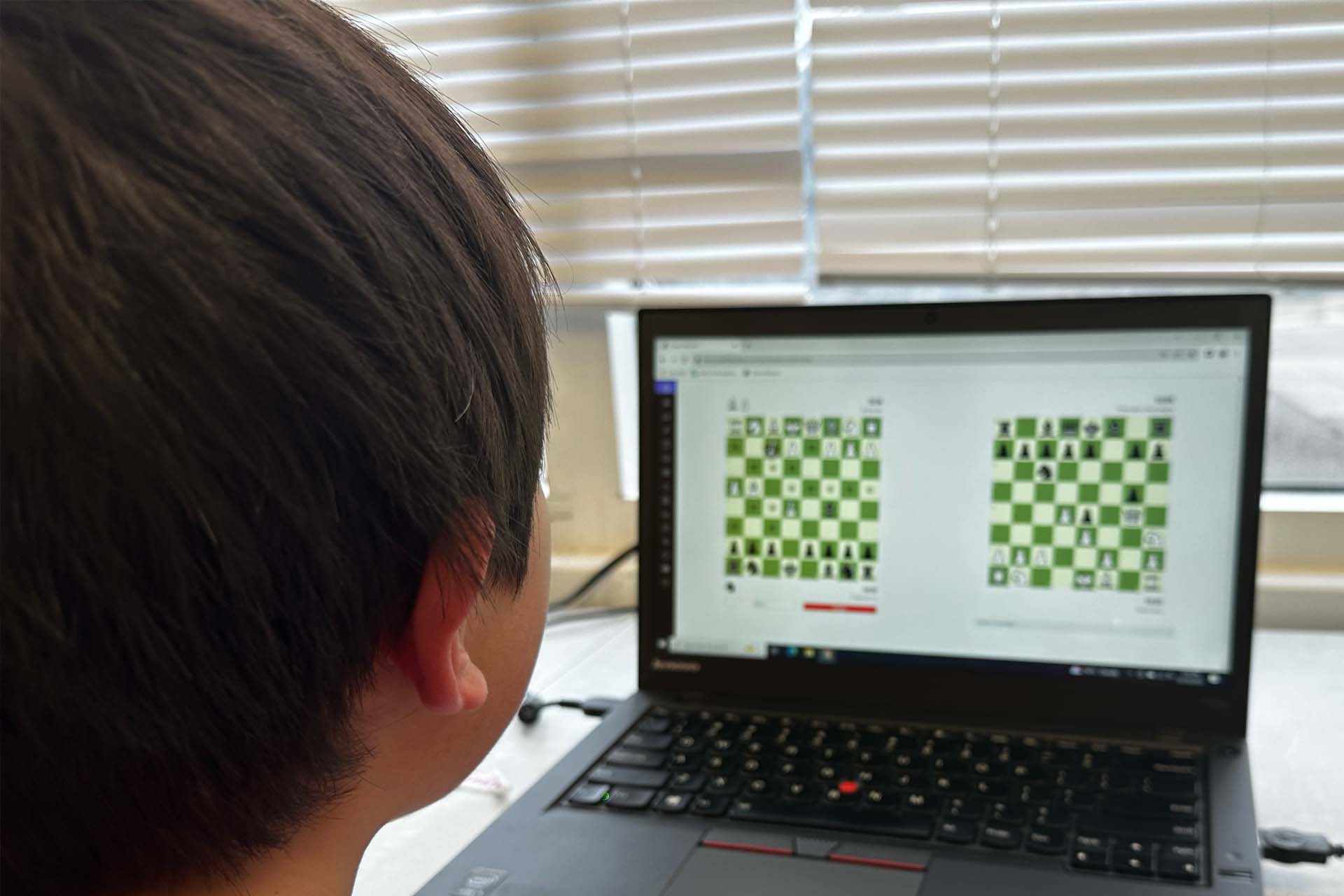
There is to be no taking of pictures of the tournament participants at any time during the tournament as this is a distraction. If you are at home and playing in the tournament online, please ensure your child's webcam is working and is on at all times during the tournament. Your child's full face needs to be seen while they are playing during their game. This helps other players, opponents to see someones facial expressions which is necessary for social interaction between players. Failure to show your live face at any time during a chess game you are participating in will result in one warning. If a second warning is issued to the participant for not having their webcam showing their live face; this will result in your opponent winning their game and your forfeiture of your game. Note: iPads and Tablets when used will not show a player's face while they are in a chess game. Use a Laptop instead as they are equipped to show a player's face and also allow a player to play their game through the web browser.
1.15. PARENTS
Parents are NOT permitted to be in the same room as your child when they are playing in the tournament, whether in-person or online, as it will distract the player.
1.16. FAIR PLAY
We take cheating very seriously. We employ a highly sophisticated fair play engine that will identify cheating. If for any reason you are flagged by our system for cheating, you will be immediately ejected from the tournament without refund. The arbiter and or referee's decision is final and there is no appeal of this whatsoever. Good sportsmanship is expected of all players and will make the event a more enjoyable experience for everyone involved. Shaking hands with your opponent before and after a game is customary. Players are encouraged to develop friendships and converse with your fellow players before the start of the game.
1.17. DRAWS
It is forbidden to distract or annoy an opponent in any way whatsoever. This includes talking and repeatedly offering a draw. A player may offer a draw only when it's their move and after making a move on the board, before pressing their clock. They must say, "I offer a draw" (or similar) to their opponent. The opponent may choose to, "ACCEPT", "DECLINE" or continue playing which is an automatic decline of the draw request.
1.18. NOTICE
Students will be provided two weeks notice of any tournament and will be given ample of notice to practice for their tournament. Multiple FREE PLAY dates will be provided for students to practice with other students on a daily basis. The MORE parents encourage their child to practice the more prepared they will be for the tournaments.
The International Chess Federation (FIDE) has come up with a set of rules and regulations for official online and in-person chess competitions.
1.20. ONLINE GAME PLAY WHILE ONLINE OR IN-PERSON:
All students must login into https://class.smartkidschess.com and, if at anytime during their tournament and or the game they are playing, they lose internet connectivity; they will forfeit the game they were playing.
All screen recordings, cameras and or microphones, as well as virtual backgrounds or green screens are not permitted.
All players’ faces, as well as surroundings, must be clear with proper lighting and players' faces must be seen at all times during the game.
Player' Parents, Friends or anyone else are not permitted to suggest, discuss, direct, advise and or in any manner provide assistance to any student player.
1.21. DEVICES
User(s) of any external devices such as cellphones, iPhones, iPads and or any type of electronic and or device of any kind is not permitted to be used during a chess tournament. Should an arbiter and or coach or official of Smart Kids Chess suspect the use of such assistive chess movement devices or helper aides in any manner; there will be a ruling in favour of the opponent and those caught or suspected of using these assistive devices will forfeit their game.
Students must only have one browser tab window open and no other tabs are allowed to be open and their ZOOM window. Players' are not permitted to use any other helper chess software, other websites and or any chess material and or program to assist them in the game of chess. Smart Kids Chess utilizes a plugin on the Tournament platform that searches for other additional browsers being used and or what other softwares are used at the time of the tournament, including identifying incognito browsers. If a student is found to be using assistive technology during a chess tournament, an arbitrator and or judge can rule in favour of the opponent.
1.22. WITHDRAW
If a Player wishes to withdraw from the tournament, the player has to communicate this request to an arbiter or their coach in writing, an email to: learn@smartkidschess.com. Once pairings for the new round are made and published, they will not be changed. Any belated “withdrawal” request will result in a forfeit of the game for which the player has already been paired.
If a Player doesn’t arrive at his/her chessboard within 10 minutes (i.e., ten-minutes) after the start of a round, the player’s game will be forfeited, the result “0F” will be entered, and the player may not be paired for subsequent rounds.
Players may be permitted to use the restroom if they request permission from the auditor or coach. Players must remember that their "Counter Timer" will not be paused while they are away from the game. The time a player is using bathroom facilities, will result in lost time.
1.23 TOURNAMENT TYPE
The Tournament Type will be SWISS. A Swiss-system tournament is a non-eliminating tournament format that features a fixed number of rounds of competition, but considerably fewer than for a round-robin tournament; thus each competitor (team or individual) does not play all the other competitors. A Swiss tournament is different than a Round-Robin tournament in that no players are eliminated. Every player will play every round, and the player with the highest number of points at the end of the tournament is the winner. In a Swiss tournament, you don't necessarily play every other player.
Touch Rule applies. If a player touches a piece on the chess board, the player must move that piece. This is based on the honour system and we are hoping all chess players abide by this rule as a means of developing self discipline. Once a move has been made, there is no take-backs and the move shall stand as it was moved.
Players can play games as fast or as slow as they need and they can choose to either "Draw" or "Resign" a game. All games will be recorded and will be reviewed by the arbiter and coach to make decisions. When a ruling on a game has been made, it will be final and without appeal.
1.24. ROUNDS
The number of rounds can be adjusted by the tournament director, coach and or arbiter at anytime during the competition based on the number of registered players. The guidelines are as follows under FIDE recommended conditions.
5-8 Players = 3 Rounds.
9-16 Players = 4 Rounds.
17-32 Players = 5 Rounds.
33- 64 Players = 6 Rounds.
65-128 Players = 7 Rounds.
129-212 Players = 8 Rounds.
213- 385 Players = 9 Rounds.
1.25. ELIGIBILITY TO REGISTER
To register, you must be aged six (6) to fifteen (15) years old and reside within the Greater Toronto Area or be a resident living within the following areas within Ontario which only include city of Toronto and the regional municipalities of Durham, Halton, Peel, York and or within the Town of Ajax, Town of Aurora, Whitby, Scarborough, Markham, Richmond Hill, Etobicoke, and North York. Proof of residency will be required to be awarded a prize from the committee.